
© Kaupo Kikkas
1938 to 1943
The music got better as its author got worse.
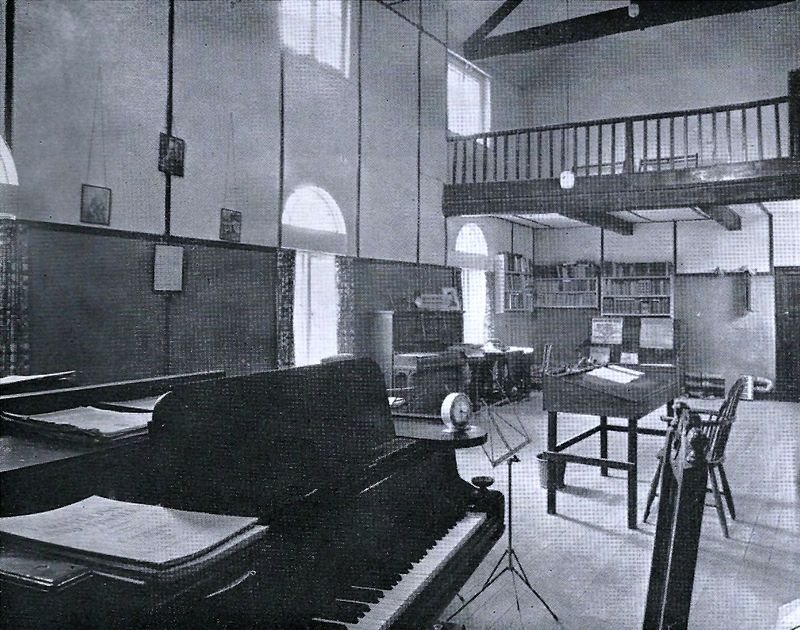
The music room at Brookhill, made for Coke out of the stable and coach house range of 1742, with its gallery at one end.
By his late twenties, Coke's family were watching a marked deterioration. Griselda Brook wrote of "the mental illness which was to blight the rest of his life", and elsewhere named it, saying that the "unspecified ailment" of her childhood was one she later understood to be schizophrenia. From his thirties he would spend months at a time in mental hospitals.
His mother's health was poor too. She suffered from pernicious anaemia, not from depression, though depression is what has usually been recorded; before the disease could be treated, its exhaustion, breathlessness and mental fogging were readily taken for melancholy.
They did not use the dining room. Meals were taken in the kitchen, converted from a fifteenth-century banqueting hall, at a huge wooden table. Brook's account of them is worth quoting at length:
Roger was always working in the Music Room, often through the night. He was very unwell during those years and at mealtimes would mutter and play an imaginary piano on the table, without taking any part in his surroundings. It was very intimidating to a small child… However, he was never violent and, although hardly aware of his surroundings, he was always gentle and non-aggressive.
Her other memoir puts the child's eye view of it more sharply. She sat at the huge kitchen table "opposite my uncle's shadowy bulk, silhouetted against the window. He endlessly talked to himself and drummed his fingers on the table, oblivious of his surroundings." Seen from that seat he was a dark, faceless, muttering terror, though he was not that to everybody in the house. He muttered as he played, as well as at meals.
He tried to teach her the piano when she was five. The lessons were taken up mostly with the Leschetizky method, a copy of which was still in his own music library at the end of his life, and she found them very boring. There were two of them, and then they stopped.
There was loneliness of another kind. In 1939 Coke set a text by his friend Ralf Allsebrook, a family friend eight years his junior, as the song November Afternoon, opus 31. His niece has spoken of how much Allsebrook meant to him. Allsebrook was killed in the war in 1943. Homosexuality would remain a criminal offence in England until 1967, and Coke, isolated, unwell, and living with his mother in a decaying house, had no version of that life available to him at all. "He was," his niece said, "most of his life desperately lonely… it was much worse for him because of his illness."
Encouragement did reach him, privately and by post. Clive Jones, who knew Coke and had his papers in front of him when he wrote about him in 1973, records "many letters from Bax at this time and later", and quotes one of them: "I played over the Piano Sonata you sent me and like it increasingly. The spare treatment of the piano is original and effective, I think." The sympathy ran both ways, Coke admiring what he called Bax's "old-fashioned romanticism". Of the songs written in 1939 Malcolm Sargent thought them "charming", and added, "Reading them I wish I was a tenor." None of those letters is in the archive now.
One piece of it was published at the time. The Nottingham Journal of 14 February 1942 reported a lunch-hour concert Coke had given the day before for students of Nottingham University College, at which he played the Fifteen Variations and four of the Preludes, and passed on what he had told the reporter: that they "had been heard and favoured by Sir Arnold Bax, one of Britain's leading musicians, and by Mr. Eugene Goossens". The same paragraph records that it was the twelfth performance of the Variations. The following year Coke wrote his third symphonic poem, Dorian Gray, and headed the first page of the score, in his own hand, "for Sir Arnold Bax". Fourteen years later Bax was the only composer he ever named as an influence on his own music.
One critic looked at it properly at the time. Loudon Merry, a composer who shared a Nottingham programme with him, wrote a long technical appreciation for The Gong at Christmas 1942, and it is still the best thing written about the music. On the Third Concerto: the piano "is very much master of the situation, in the romantic tradition, from the first few bars, where it twice interrupts the initial unison theme given out by the strings, to the end, where instead of joining in the final chord with the orchestra, it leaves the orchestra behind and says the last word itself". On the Second Symphony, heard once and never since: "the composer makes no concession to the hearer, and it contains some of his boldest dissonances and most advanced part-writing". On the Preludes: "They stand halfway between those of Chopin and Rachmaninoff from the point of view of importance, but have little in common with either of them." Merry also reported what Coke thought his own best piano work, which was the Fifteen Variations and Finale.
Against all of that, the output of these years is remarkable. It includes the Second Cello Sonata, opus 29; the Third Piano Concerto, opus 30; the Elegiac Trio, opus 32; both books of the Twenty-Four Preludes, opuses 33 and 34; the Fifteen Variations and Finale, opus 37; the Fourth Piano Concerto, opus 38; the Prelude to The Cenci, opus 41; and the Third Cello Sonata, opus 44. He also gave several dozen concerts, in Bath, Derby, Manchester, Nottingham, Torquay, and repeatedly at home.
Two of those works can be dated to the day, and they run straight into one another. The autograph of the Second Cello Sonata carries its span on the first page of the music, "Sept. 28 - Oct. 23", and repeats the finishing date at the end. The first page of the full score of the Third Piano Concerto is headed in his own hand "R. Sacheverell Coke. Opus 30 (1938) [Oct. 23 - Dec. 10]". He finished the sonata and began the concerto on the same day, in the same month that he burned seventeen of his works.
The Twenty-Four Preludes are the best way into his language. Their architecture is a deliberate act of allegiance: two books, of eleven pieces and thirteen, mirroring Rachmaninoff's opus 23 and opus 32, and following the key sequence of Chopin's opus 28, a line that runs back through Scriabin and Alkan to the Forty-Eight. What is his own is a habit of interruption. A prelude will suspend itself mid-thought, the pedal held down, in a passage of quasi-recitative that seems to speak inwardly rather than out. Then a single dissonant chord breaks in and stops the mood dead. That second gesture, an interruption motif, turns up in the Third Piano Concerto and twice in the Second Cello Sonata as well. In the cello sonatas the same instinct shows itself as texture: the pianist's hands two octaves apart, single lines with nothing between them, clashing appoggiaturas a semitone from the note they lean on. It is a cold, bare sound, closer to Shostakovich, whose own Cello Sonata was two years old, than to the Rachmaninoff everyone kept invoking.
In September 1940 Coke founded an orchestra of his own. The Brookhill Symphony Orchestra gave its first concert that month in the music room: forty players, Coke's Second Symphony and his Third Piano Concerto, the concerto played by the composer. The Musical Times noticed it from London. That November another Brookhill series began, three Sunday afternoons in aid of the R.A.F. Benevolent Fund; the first, on 3 November, was two cello sonatas and a piano trio, all his own. Coke wrote to a local paper about the orchestra with obvious pride: "They play splendidly."
The orchestra was a serious undertaking, and so were its programmes. Rob Barnett records that it played symphonies by Bruckner, the Fourth and the Sixth, Mahler's Fourth and Rachmaninoff's Second, alongside Coke's own music: repertoire that London orchestras were not much playing in the 1940s, given in a Derbyshire music room by a band Coke had raised himself. By February 1941 the Nottingham Journal was describing an orchestra of more than fifty amateur and professional players.
On the 22nd of that month it went into Southwell Minster under C.E.M.A. auspices with Richard Austin conducting. The programme was a statement of everything Coke cared about, put on in the second winter of the war: Rachmaninoff's The Rock, which had not been heard in England since 1898, the first performance of the Prelude to The Cenci, and the Third Piano Concerto with the composer at the piano. After the interval, the Siegfried Idyll and Brahms's Third Symphony. A collection was taken for the R.A.F. Benevolent Fund. He had built, in a mining parish of six thousand people, an orchestra capable of that evening.
The Third Concerto had already reached a national audience. On 3 August 1939, a month before the war, Charles Lynch played it with the Bournemouth Municipal Orchestra under Austin, broadcast by the BBC on the National Programme with Eugene Goossens producing and Harold Fairhurst leading the orchestra. Both names come back later: Goossens conducted The Cenci twenty years afterwards, and Fairhurst gave the London premiere of the Elegiac Trio in 1943 and was paid fourteen guineas for it out of the Brookhill housekeeping. Writing his own note for the Radio Times, Coke set out what a listener would hear and what he would not: "If one looks for a spiritual forbear, one is reminded of Rachmaninoff's First; this, however, does not mean that the concerto is at all like anyone else's, or at all conservative or unadventurous in its idiom or procedure." It is the most articulate sentence he ever wrote about his own music. Nearly thirty years later he still called the concerto his best.
The R.A.F. collections were not the end of it. Some time in 1942 Coke was asked, by whom is not recorded, to write an elegy for airmen who had been killed, and he wrote it: the Elegiac Ballade, his second symphonic poem, opus 51, composed in November and orchestrated between March and June of the following year. The Derbyshire press said in October 1943 that it was "a tribute to several of his friends who have given their lives in the R.A.F." One of them was almost certainly Ralf Allsebrook, whose words he had set in 1939 and who had been killed that September. Every printed account gives the dedication as the pilots of the Royal Air Force. The first page of the manuscript is fuller, and it is in Coke's own hand: "dedicated affectionately to the pilots of the Royal Air Force, and the pilots of the Fleet Air Arm." Twenty years later, in pencil below the title, he added four words in square brackets: "Not yet performed - Oct. 19 62". He had been asked for a piece, he had written it, and two decades on nobody had played it.
The same note carries one more sentence: "His Second Symphony, dedicated to Rachmaninoff, is to be produced by Eugene Goossens at Cincinnati shortly." Goossens was then conductor of the Cincinnati Symphony Orchestra, and had it happened it would have been the only hearing of Coke's music outside Britain in his lifetime. It never took place. The orchestra's own yearbook for 1950 to 1951 prints a cumulative list of everything it had played since its first season in 1895, and Coke is not in it. War broke out four weeks after he wrote the sentence.
Contents · Previous: Burning the evidence · Next: Rachmaninoff
© Simon Callaghan 2026. This account was written from my own research archive on Roger Sacheverell Coke, with AI assistance in drafting. Every statement in it rests on a document listed on the sources page.