
© Kaupo Kikkas
The wartime concerts at Brookhill and around the Midlands were the last period in which Coke was regularly heard. He appeared at the Manchester Tuesday Mid-day Concerts in May 1941, where the Manchester Guardian found his sincerity "obvious" but thought that in the Variations "he has been too eager to exhaust every possibility of development he could find. The material pans out rather thinly towards the end." The notice ends by recording that "a very squeaky piano stool was a disturbing influence during his performance".
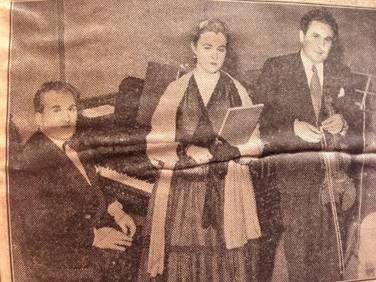
Coke with Barbara Welby, who gave the first performance of more of his music than any other singer, and the violinist Jan Sedivka. From a press photograph.
Something happened at the turn of 1949 into 1950 that the works list records without explaining. A dozen pieces in his own printed catalogue carry two dates, an original one from the war years and a second of 1950: the Clarinet Sonata, the Variations on Rachmaninoff's song, Dorian Gray, the Second Violin Sonata, and The Cenci itself. He had gone back to all of them at once.
An aunt's letter of 25 February 1950 supplies the reason. "I was so delighted to hear that you've been able to work again," she wrote, "a really enormous amount from what you write, though I must admit I'd a bit of a job to decipher it. Neither you nor darling Mama would get a prize for legibility." He had not been able to work, and now he could, and had written to tell her so at length. The same letter contains the other thing everyone around him seems to have been thinking: "I do wish the BBC would do some of your things... there must be others including yourself who we never hear."
In the 1950s he took his music to London, and London was merciless. He gave two concerts at the Wigmore Hall in October 1950, a week apart, another in October 1951, and another on 2 January 1956.
The 1950 pair were not a vanity exercise. Between them they gave nine works their first hearing in London and five their first hearing anywhere, and the players were professionals. On 3 October the cellist Sela Trau gave the London premiere of the Second Cello Sonata; the flautist John Francis, the violist Bernard Davis and Coke gave the first performance of the "Ortina" Trio; and Barbara Welby sang from the Rhymes and Roundelayes.
Barbara Welby matters more to this story than any other performer, and until recently almost nothing was known about her. A great-granddaughter of Jenny Lind, married to Sir Oliver Welby, she appeared professionally under her own family name of Lind, which is why the sources give her two. She had been singing Coke's songs since 1936, wrote the poem he set as the Second Vocal Concerto and had that concerto dedicated to her husband, and gave the first performance of more of his music than anybody else.
A week later, on the 10th, Watson Forbes played the first performance of the Viola Sonata, Welby sang eight of the Burns settings and the London premiere of the Beaumont and Fletcher songs, and Welby and the contralto Marianne Mislap-Kapper sang two scenes from the second act of The Cenci, nine years before it reached a stage. In October 1951 Trau came back and played all three cello sonatas.
The players thought better of the music than the critics did, and tried to help. Watson Forbes wrote to Coke's mother eight days after the second concert, thanking her for "the generous cheque" and reporting that "the viola sonata went so well. I can quite understand Roger being so tired after two such concerts; it takes a lot out of one!" Then he offered practical advice: try Manchester or Birmingham for a broadcast, and "I should be very pleased to play it again". Barbara Welby was working the same ground from Sloane Street, offering to take his concertos round the young pianists she knew, and closing with the sentence that sums up fifteen years of it: "I do wish some of the things I have mentioned to you in the last year or two had come off, but the musical world is tough going!"
Nothing came off. Between August 1939 and August 1971 the BBC broadcast nothing of his at all. The Stage covered the 1950 series and caught the atmosphere exactly: "it must be admitted that a general depression rested on the scene, which the wistful melancholy of Mr. Coke's music did not easily dispel." Of the music itself: "He has a feeling for 'atmosphere,' but the deliberate avoidance of melody in his compositions makes them connoisseur-pieces rather than attractions for the wider public."
In 1951 Sela Trau played the three cello sonatas with Coke at the Wigmore. Richard Capell, in the Daily Telegraph, disposed of him in a line: "Mr. Coke is a fluent writer who seems to give only half his mind to the art of composition." The Stage was worse for being kinder. "As beginner's efforts they showed great promise." Coke was thirty-nine.
The January 1956 concert brought two heavy blows on the same morning. The Times:
The predominating emotion of all that he writes is nostalgia, and often he dissolves it in poetic and sensuously attractive sounds. But there is too much nostalgia; the composer has little else to offer, with the result that nearly every movement of each work had the same kind of flaccid effect on the listener.
Then the advice that has been quoted against him ever since: "Some intensive study of Bartok and post-1914 Stravinsky would do him no harm." In the Daily Telegraph that morning, its critic called him a "Rachmaninov-follower, or perhaps addict would be a better word", and dismissed "the composer's invertebrate piano style."
The best answer to that came a year later, from a friend, and it was a musical one. Writing in Derbyshire Countryside in 1957, Hugo Meynell picked out the Elegiac Trio: its first movement "is very skilfully derived from one single phrase (as should be observed by those critics who accuse this composer of excessive rhapsodising!) and the scherzo is a movement of immense passion and forcefulness". Nobody else in Coke's lifetime engaged with the music closely enough to say anything of the kind.
He answered the charge himself that month, in print, though not to the critics. In the January 1956 number of The Gramophone, on sale in the same weeks as those reviews, a contributor had written that Bax had had no influence on contemporary British composers. Coke replied: "This is quite untrue. I know many pages in my own work of the last 15 years that would be quite different had I known no Bax." Nowhere else in the surviving papers does he name an influence on his own music, and the name here is not Rachmaninoff. Fifteen years back from 1956 is 1941, which is the second book of the Preludes, the Third Cello Sonata and the First Violin Sonata. He signed it "Pinxton, Derbys."
The same letter carries one more thing, offered in passing and impossible to check, since it can only have come out of his own conversations with a man who had been dead thirteen years: "Rachmaninov considered Bax the greatest composer we here in England have had for a very long time, being particularly struck by the 3rd Symphony."
Derbyshire closed ranks. In the Derbyshire Advertiser that same week Hugo Meynell wrote that "there is no chasing of systems or flogging of theories in Mr. Coke's art, but we have here the full power of lyric warmth that so many twentieth century composers have forsaken to their loss". It is a real argument, and probably the one most likely to be made in his favour today. A week later the same paper carried a consoling paragraph: a friend who had attended reported that the concert "was well attended". In Coke's own cutting album, beside that phrase, someone has written a single word in ink: No.
Contents · Previous: Paying for it · Next: The Cenci
© Simon Callaghan 2026. This account was written from my own research archive on Roger Sacheverell Coke, with AI assistance in drafting. Every statement in it rests on a document listed on the sources page.