
© Kaupo Kikkas
The Cokes had been at Brookhill, just outside the pit village of Pinxton on the Derbyshire and Nottinghamshire border, since the sixteenth century, and in Derbyshire long before that. They pronounced the name Cook. Coke's niece Griselda Brook, who was sent to stay there alone from infancy in the 1940s, described the house without sentiment: "a large, grim and architecturally confused collection of buildings", a twelfth-century keep with an Elizabethan wing and an Adam-style drawing room bolted on, standing in a park that the National Coal Board would later strip for opencast mining. There was no electricity, no central heating, and a great deal of dry rot. "Whenever it rained," she wrote, "the roof leaked in many places. I remember the alternative Brookhill music of drips falling into enamel buckets placed round the house."
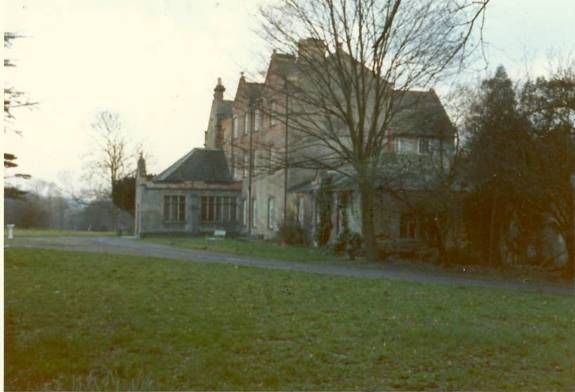
Brookhill Hall about 1960. From the papers of Griselda Brook.
A visitor of the later 1960s saw it more kindly and just as bleakly. Roy Christian came out for an afternoon to write the house up for a county magazine, and found an entrance hall of oak sideboards and mounted antelope heads, a library panelled in oak painted white and hung round with the arms of families that had married into the Cokes, a dining room with a carved chimneypiece brought over from Kirkby Old Hall, and a staircase whose walls had just been repainted a magenta blue. He also found "many locked doors and shuttered windows in the house", and a Georgian drawing room, added about 1770, that was no longer used. Until 1965 that room had held Joseph Wright of Derby's conversation piece of the Rev. D'Ewes Coke, his wife Hannah and Daniel Parker Coke, the first item on the schedule of heirlooms the family had bound itself to keep. Coke sold it that year to Derby Art Gallery, where it hangs now.
The terms on which the family held it were set out four years before Coke was born, and they were not lenient. On 2 November 1908 his grandfather, Colonel William Langton Coke, conveyed the whole estate to the Public Trustee: thirty-three sides of engrossed conveyancing, bound, with two hand-coloured Ordnance Survey plans and a schedule of heirlooms. The heirlooms are a small inventory of what the house was supposed to keep for ever, headed by Joseph Wright of Derby's conversation piece of the Rev. D'Ewes Coke, his wife and Daniel Parker Coke, and running on through thirty-two more pictures, a fragment of tapestry with a view of Brookhill Hall in its border, a punch bowl of 1699 called the Coke Bowl, every clock in the house made before 1800, and a diamond tiara. The deed also defines the grounds usually occupied with the Hall as "about Thirty one acres" and names them one by one: the Moat Close or Half Moon Pasture, the wood as far west as the first cottage in Brookhill Lane, the Moat Close Pool and the lawn. When the house was finally sold in 1974 it went with eight and a third.
And it made living there a condition of being paid. Under clause 12 the heir's annuity, twelve hundred pounds a year rising to eighteen hundred, was to be cut by three hundred a year if he made "default in occupying Brookhill Hall" or let it fall out of repair, and "failure to personally occupy Brookhill Hall aforesaid for six continuous months at any time after the death of Colonel Coke shall be deemed a default within the meaning of this clause". The clause bound Coke's father, who was killed the year after the Colonel died and never had to live under it. It is the frame the whole family was arranged in: the Cokes were to be at Brookhill, or be paid less for being elsewhere, and the pictures were to stay on the walls.
The arrangement outlasted everybody who made it. In September 1950, thirty-seven years after the Colonel died, the District Estate Office of the Railway Executive at Derby sent Brookhill Hall a printed form headed THIRD APPLICATION, asking for one shilling of rent on land near Langton Colliery, with two shillings of arrears, the account still standing in the name of "Col. Coke's Trust". They had the composer's initials wrong.
The money came out of land and coal. His mother kept the household accounts in a ledger, and the war years in it read like the inventory of an establishment in slow retreat: rates to the Blackwell Rural District Council and to Kirkby, tithe of twenty-eight pounds twice a year, a premium to the Commercial Union, coal delivered from Pinxton Collieries by the ton, straw, a car licence, a telephone bill of six pounds. Against that she paid wages to Nelly, Daisie, Harold, Letty, Evelyn, Annie, a man called Freeman who drove, and Julie Baud, the French governess who had come into the house for Coke's sister when she was a child and stayed until her death in the 1960s. Everything Coke did in music was paid for out of that column.
His father's death left the two-year-old Roger as lord of the manor in all but name. His mother, Dorothy Maye Coke, never remarried and lived at Brookhill until her death in 1957. She idolised her son. Brook, who was Coke's sister's daughter, is unsparing about what that cost the other child in the house. Roger went to Eton; his elder sister Elizabeth had her lessons from two retired teachers in the village and a bedroom in the servants' attic. "She went in the back of the car with the luggage," Brook's father used to say.
The village had its own view of him. Peter Hardy, whose father grew up in Pinxton, was told, and heard it repeated independently by his father's old friends sixty years later, that "Roger was a very timid boy and the local toughs picked on Roger whenever they got the chance". His father made a point of stopping it, and "Roger and his family never forgot that". The Pinxton children played sport on the grounds of a house his family effectively owned, and picked on the boy who lived in it.
The indulgence did not spoil him. Everyone who knew Coke says the same thing. "Despite such indulgence," Brook wrote, "Roger was always a loving, unspoilt person." He was, she said elsewhere, "not of this world, a complete innocent and incapable of cruelty or meanness."
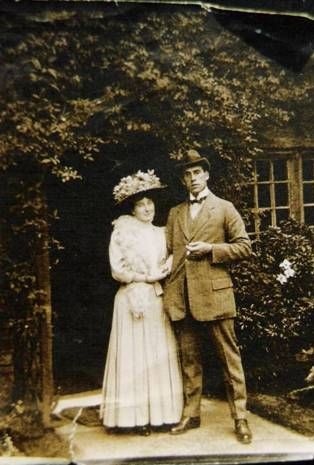
Coke's parents outside Brookhill Hall: Lieutenant Langton Sacheverell Coke, killed at Ypres on 31 October 1914, and Dorothy Maye Huntingford, photographed at the time of their engagement. From the collection of Jenny Taylor.
© Simon Callaghan 2026. This account was written from my own research archive on Roger Sacheverell Coke, with AI assistance in drafting. Every statement in it rests on a document listed on the sources page.