
© Kaupo Kikkas
Coke went on writing. Almost everything completed after 1950 is songs, apart from the Variations, opus 73, written for Julie Baud, the family's French governess, who had been in the house since his sister was a child.
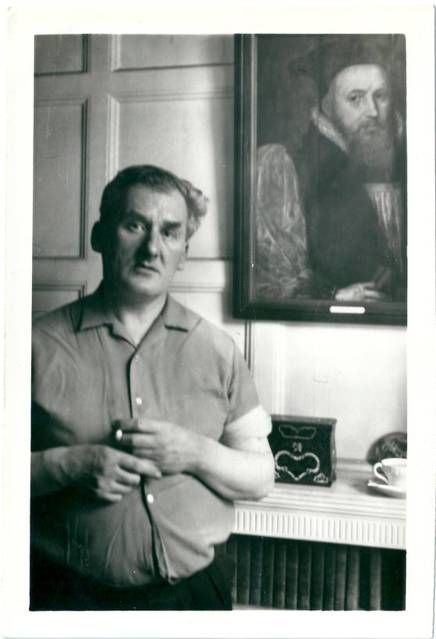
Coke in middle age. From the papers of Brian Suter, the Mansfield tenor who sang his songs in the 1960s.
The late songs are the part of the output least looked at and, on the evidence of the poets he chose, the least conventional. In 1954 he set six poems of Emily Brontë. In 1956 he set Tagore twice over, twelve songs in a year, in the Gitanjali translations that had been fashionable in 1913 and were nobody's idea of a subject forty years later. In 1957 came six settings of Walter de la Mare, and in 1958 a single de la Mare song, "Thule", which the soprano June Chambers sang at the Nottingham Tuesday Music Club that February. Yeats occupied the last decade, in a set of four and a separate song, and there are three settings of D. H. Lawrence.
The choices look like a reading list: a man in a cold house choosing poems about solitude, memory and the end of things, and setting them for a voice he mostly had to imagine. Only a handful of them were ever sung in his lifetime, and most have not been sung since.
Several large works were begun and abandoned: a Violin Concerto in 1960, a String Quartet in 1971, a Piano Quintet, a Second Trio, a Fifth Cello Sonata. Only one movement of the Fifth Piano Concerto, "The Orton", survives, a slow movement marked Andante piacevole, ending with a plain perfect cadence over the direction con dignità. He published it in 1959, two years after his mother died.
Contents · Previous: The Cenci · Next: Printing it himself
© Simon Callaghan 2026. This account was written from my own research archive on Roger Sacheverell Coke, with AI assistance in drafting. Every statement in it rests on a document listed on the sources page.