
© Kaupo Kikkas
On 22 March 2012, forty years after Coke's death, the full score of the Third Piano Concerto was found. It had been presumed lost, and it turned up in the middle of a photocopy of The Cenci in a parcel Coke's nephew had given to the writer Gareth Vaughan. Everything since rests on that afternoon.
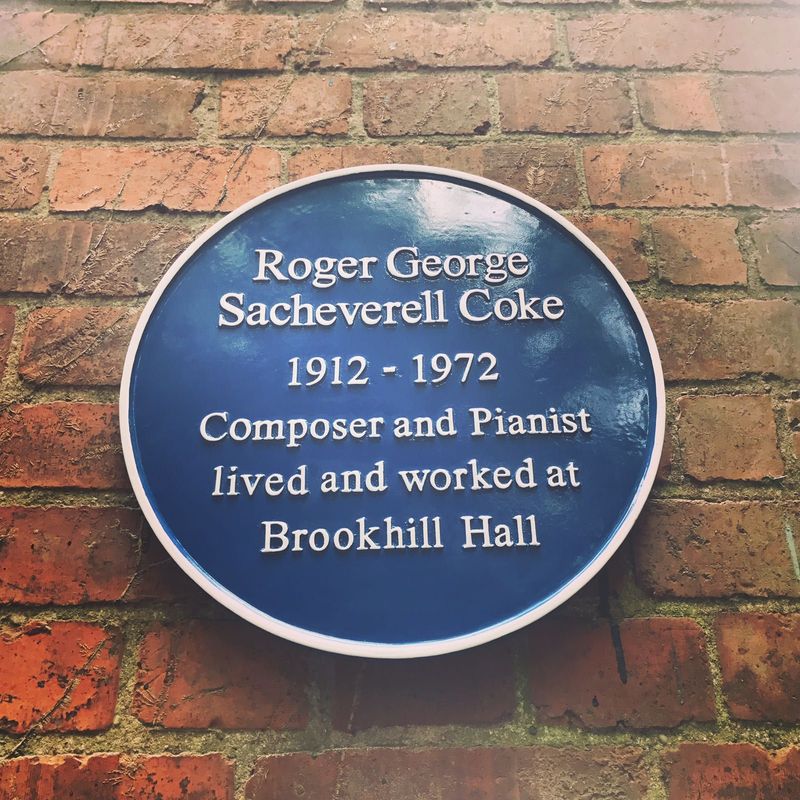
The blue plaque at Brookhill Hall, unveiled on 3 June 2017.
For forty years almost nothing happened. There were memorial concerts at Alfreton Hall in the 1970s and one in 1981. Alexander Baillie and Piers Lane recorded the Second Cello Sonata in 1984, and BBC Wales broadcast it on 14 November 1987. One evening in between, a soprano called Linda Darnell closed a mixed programme at the Mansfield Community Arts Centre, on Saturday 15 September 1990, with two of the Six Songs opus 19. They came after Charles Ives and before nothing: they were the last two items of the night. It is the only performance of Coke's music anywhere between 1987 and 2012 that anyone has been able to find. Rob Barnett wrote a short life in British Music Society News in 1992 and ended it with an appeal: "I wonder if anyone else remembers performances of other pieces by Coke or has recordings. I hope that someone might be prepared to share them." The first commercial recording of any music by Coke was made in 2013.
Since 2015 that has changed. The pianist Simon Callaghan has recorded the complete Twenty-Four Preludes and the Fifteen Variations and Finale for SOMM; the Third and Fourth Piano Concertos, with the surviving movement of the Fifth, for Hyperion, with the BBC Scottish Symphony Orchestra under Martyn Brabbins, a disc that reached number three in the Official Specialist Classical Chart; and the three cello sonatas with Raphael Wallfisch for Lyrita. The First Violin Sonata was recorded by Rupert Marshall-Luck and Matthew Rickard for EM Records in 2013. New performing editions of the cello sonatas have been published by Nimbus. The concertos can be heard on Spotify and Apple Music, and there is a short film made around the recording sessions in Glasgow. A full list of the releases is on the recordings page.
The papers came through as well, which is not usual and is most of the reason this account can be written at all. Coke's manuscripts and his two albums of cuttings went to Chesterfield Library, and are due to transfer to the Derbyshire Record Office at Matlock. The family papers, including his mother's diary and her household accounts, went to the Derbyshire Record Office. His letters to Eugene Goossens are at the British Library, MS Mus. 1172, ff. 1-10, 24 and 26-28, in the second volume of the Goossens correspondence; the same library holds letters from him to Alan Bush, running from 1955 to 1969, in the Alan Bush Collection; and the letters he wrote to Brian Suter stayed with the singer. Nothing was systematically weeded, which means that alongside the concert programmes and the printed catalogues there are wage columns, coal deliveries and the fee paid to a violinist in December 1943. A composer who never had an institution behind him has ended up with a better documented working life than many who did.
Coke is not a lost master and the case for him does not need overstating. The criticism made at Eastbourne in 1934 and in The Times in 1956, that the music is long, that it repeats itself, that the argument does not always arrive anywhere, is not baseless, and no performer who has worked on it would pretend otherwise. But the charge that he was merely a Rachmaninoff imitator does not survive a look at the scores. The bareness of the cello sonatas, the sudden interruptions in the Preludes, the recitatives that turn inward and stop the music dead: these are not borrowings. They are the sound of a particular man working alone in a converted stable on the edge of a Derbyshire pit village, for an audience that mostly did not come.
The Nottingham Journal was right in 1936, if not in the way it meant. Writing about the music room after a concert there, its reporter observed: "This 'stable' is now Mr. R. S. Coke's den and someday I venture to think it will figure in a musical history, one of the first chapters of which was written on Saturday."
© Simon Callaghan 2026. This account was written from my own research archive on Roger Sacheverell Coke, with AI assistance in drafting. Every statement in it rests on a document listed on the sources page.