
© Kaupo Kikkas
Twice, once in 1950 and again in January 1958, Coke had a list of his works printed. The two leaflets are the nearest thing he has to a publisher’s catalogue, and he was the publisher, in the literal sense as well as the figurative one. Robert Innes-Smith, writing just after his death, named four works he had printed at his own expense: the Third Piano Concerto, the First Vocal Concerto, the Second Cello Sonata and a book of the Preludes. The library catalogues show that the four were seven. The Fifteen Variations went out in 1959, the Third Piano Concerto in 1960 in the composer’s own two-piano arrangement, the twenty-four Preludes as a single volume of sixty-four pages in 1969, the First Vocal Concerto and the Poem in 1970, and the two cello sonatas, the first as well as the second, in 1972, which was the year he died. He was still paying to have music printed in the last months of his life.
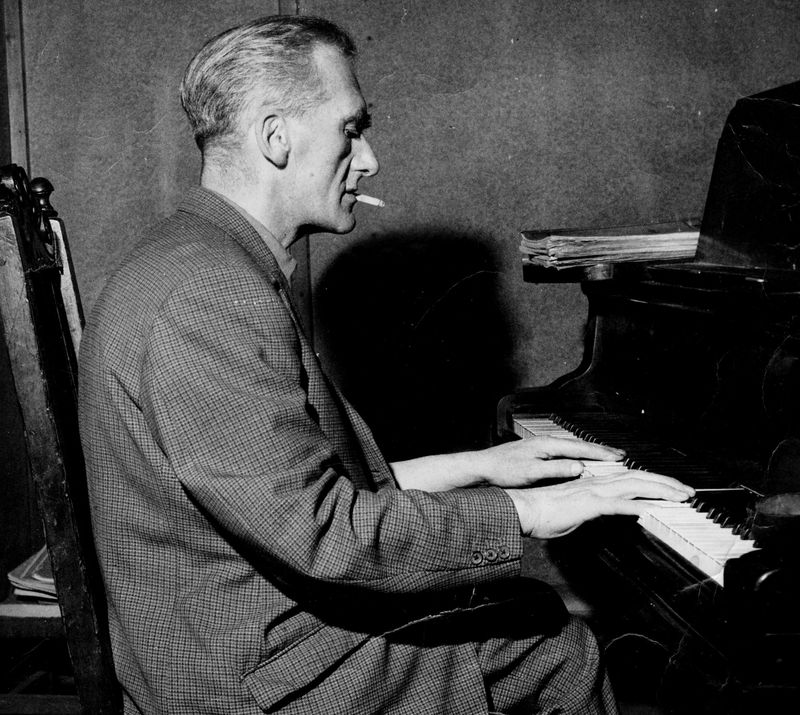
Coke at the piano, smoking. From the collection of Jenny Taylor.
The division of labour is visible on the scores themselves. Coke holds the copyright on every one of them, in his own name; Chappell engraved the plates, and their name appears only in the footer of the pages of music beside the plate number, where an engraver's name goes; and the printing was done by Lowe and Brydone of London. Three firms doing three jobs, and the only one of them that is publishing is him. Both leaflets end with the same sentence: "All details from R. S. Coke, from whom scores of his work may be obtained and orchestral material had." A composer with a firm behind him does not have to write that line.
What it cost is visible too. "At considerable expense he had these beautifully produced works sent out to people he hoped might take notice, but with little result." A visitor to the music room in 1971 saw the result on the floor, in "piles of printed work that looked painfully like publisher’s unsold stock". Family possessions were sold to pay for the printing, among them the Wright of Derby portrait of the Coke family and the Pinxton china made on the estate in the eighteenth century by one of his own forebears. The Wright went in 1965, bought from him by Derby Art Gallery, where it hangs today: the first item on the 1908 schedule of heirlooms, the thing the family had bound itself never to sell, turned into cash by the last of them seven years before he died.
Two of the printings were noticed in Music and Letters. The Variations were reviewed in October 1961, in a column that took in eight publications at once: the reviewer found "a composer who knows what sort of music he wants to write. That it had already been written before he began has not daunted him." The Preludes were reviewed in January 1970, sharing a page with four piano pieces by Arnold van Wyk, and the notice says in its first sentences what the printing itself says: "Each piece burns with expressive intent, an intent so strong that it persuaded the composer to publish the work himself."
Both notices are a page or two of a review column and neither is a career. But they mean that the scores exist and were sent out, and the copies are still there to be read: the British Library has four of them, and Cambridge, Edinburgh, Oxford, Dublin, Sheffield, Nottingham and both London conservatoires hold the rest. The 1958 list opens by noting that articles on the works appear in the fifth edition of Grove, in Blom’s Everyman’s, and in the Danish Musikens Hvem Hvad Hvor, which is the sort of thing a man keeps track of when nobody else is keeping track of it for him.
At the foot of the 1958 list is a short paragraph that amounts to his own account of his public career: "The following works have been broadcast by the B.B.C.: The withdrawn 2nd Piano Concerto and First Symphony; the 3rd Piano Concerto; 2nd Cello Sonata; First Piano Sonata; Elegy op. 16; three songs from op. 19."
Seven items, in a working life of some twenty-eight years by that date, and two of the seven were pieces he had burned in 1938. The BBC had broadcast more of the music he destroyed than of the music he kept.
The surviving Radio Times billings bear him out, and add the one detail his own list withholds. Five of the seven can be matched to a date. The Second Concerto went out from Bournemouth in March 1934. On 1 April 1936 the Midland transmitter gave a half-hour headed "Music of Roger Sacheverell Coke", in which Barbara Welby sang three of the op. 19 songs, Coke played the First Piano Sonata, and the Elegy was given with Leonard Carrodus; that single evening accounts for three of his seven items. The Third Concerto followed in August 1939. His own list says "three songs from op. 19" and does not say which; the billing names them: "No longer mourn for me", "The Daffodils" and "When the lamp is shattered".
The same sheet carries one more thing. Printed in its place among the concertos is "6th Piano Concerto in C minor, op. 63 (1951) (unfinished)", and somebody has afterwards drawn a line through the whole entry by hand. Sketches for that concerto survive from 1954, 1965 and 1969: he began it at thirty-eight and was still turning it over at fifty-seven. He never finished it. Across the top of the same sheet, in the same blue ballpoint, are three words that would do for the whole catalogue: "Composed at Brookhill".
The public life shrank to almost nothing. A photograph taken in the music room around 1965 shows him at the Steinway with manuscript books open, LPs and scores on the floor, and two piles of the newly published Twenty-Four Preludes, which he was posting out to anyone he thought might play them. He is smoking. He chain-smoked, at least sixty cigarettes a day by his niece's account, and his shoes are worn through.
The Sunday Express of 18 December 1966 reported that he was offering more than a thousand pounds of his own money to have the Third Piano Concerto recorded, with himself at the piano. He had tried before: "two years ago I approached a company who agreed, but unfortunately they went bankrupt." He was under no illusion about the terms. "I am prepared to have to pay as I'm not well known enough for them to do it for nothing. I always have to pay for things, probably because I live in a hall." Twenty-eight years after writing it he still called that concerto his best. The record was never made, and the first commercial recording of any music by Coke was made in 2013, forty-one years after his death.
Late in life he went over to the Louth Gramophone Society in Lincolnshire and was photographed with the members; the local paper spelled his name "Sachaveral Coke, of Pinxton Hall".
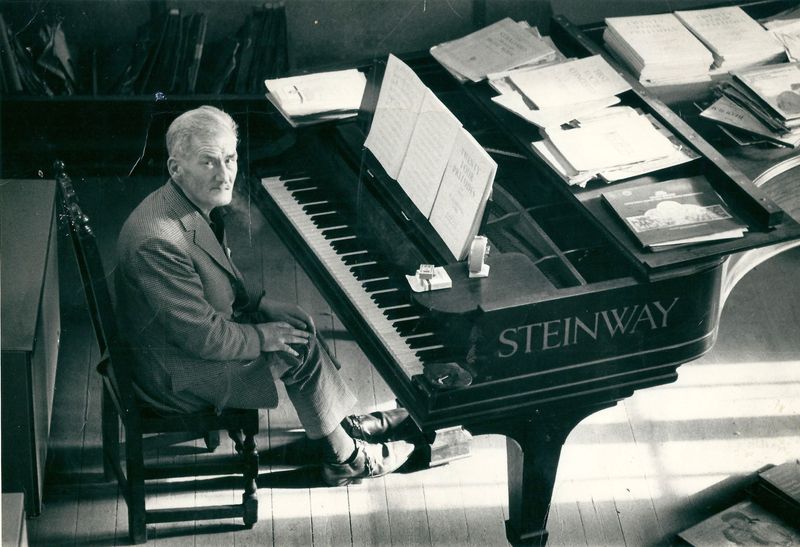
Coke at the Steinway in the music room, manuscript books open and printed scores stacked on the floor. From the papers of Griselda Brook.
Contents · Previous: The late works · Next: The end
© Simon Callaghan 2026. This account was written from my own research archive on Roger Sacheverell Coke, with AI assistance in drafting. Every statement in it rests on a document listed on the sources page.