
© Kaupo Kikkas
1931 to 1935
What turned Coke to music was a gramophone record. He told two interviewers, sixteen years apart, that he decided at eighteen to follow "the hard calling of a musician" after hearing Moiseiwitsch play; Moiseiwitsch encouraged him, became a friend, and sent him to his own former pupil to learn the piano.
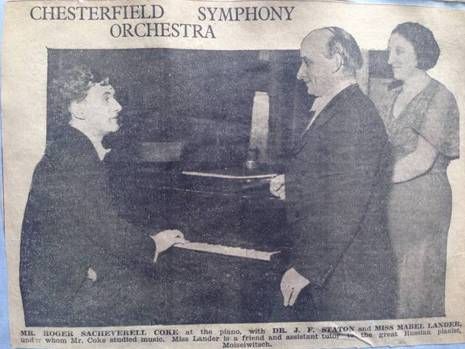
Coke at the piano with Dr J. Frederick Staton, his theory teacher, and Mabel Lander, who taught him the piano. From a press photograph.
He left Eton in 1930 and studied the piano with Mabel Lander, on Benno Moiseiwitsch's recommendation. She had trained at the Berlin Hochschule and then with Leschetizky in Vienna, made a career in Dublin as a concert pianist, and stopped playing in public when rheumatism took her hands. Moiseiwitsch had taught her during the first war and it was he who persuaded her to come to London, where she became his teaching assistant; her other pupils included the Princesses Elizabeth and Margaret and Malcolm Sargent. Coke was two steps from Leschetizky, and the school founded in her memory after her death advertised itself as teaching "the Russian and Viennese traditions", which is a fair description of what he was given.
For composition he went to Alan Bush, of whom he said in 1962 that "he taught me all I know and taught me to write MY OWN MUSIC". His theory teacher was the Nottingham conductor J. Frederick Staton. His niece believed he also studied in Germany in the early 1930s.
In October 1932 the First Piano Concerto was given its first complete performance at the Bath Pump Room, twice in one day, with the composer at the piano. "To hear Roger Sacheverell Coke play the solo part of his concerto for piano and orchestra," reported the Bath Chronicle and Herald, "music-lovers came from Honiton, Eton, Derbyshire, and Ipswich." Among them was Sir Charles Hobhouse, the Liberal politician, with his wife. Hobhouse had been Financial Secretary to the Treasury and then Postmaster-General, and the young officer who left the Irish Guards in 1908 and went into Whitehall as his private secretary was Coke's father. Eighteen years after Ypres he came to Bath to hear the son play. The Tatler had noticed him a year earlier and now returned to the charge: "This is ROGER SACHEVERELL COKE, aged nineteen or twenty, who only left Eton just over a year ago and gave two performances of his own concerto with the Pump Room orchestra. It was a great achievement and received with great enthusiasm… I hope that we shall hear it again in London before long."
They did not.
The Second Concerto followed at Bath in November 1933, and the local verdict was warm and specific. The Bath Chronicle & Herald thought it revealed "a remarkable and praiseworthy advance in structure and thematic development. Achievement has replaced aspiration." The Western Daily Press found his idiom "likeable and easily understood, and his melodic and harmonic invention fluent and spontaneous", and then made the comparison that would follow him for the rest of his life: the Second was "a more virile and independent work than the First, which latter showed too many unmistakable traces of Rachmaninoff's influence."
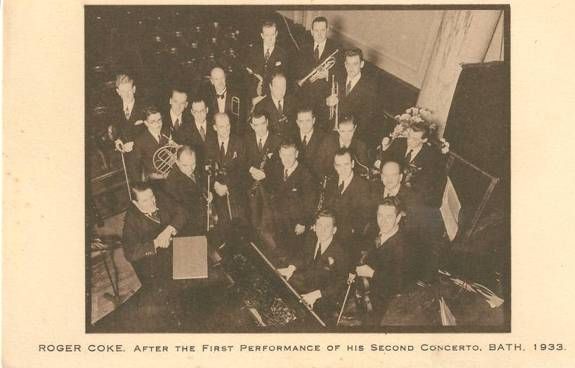
Coke with the orchestra after the first performance of his Second Piano Concerto, Bath, 1933. It is the only photograph known of him with players of any kind. The words are printed on the card; where the print came from is not recorded.
He had been abroad that year, once. A Derbyshire newspaper mentions in passing that "last April he gave a concert in the Berlin Embassy", and that single clause is all there is: no programme, and no record of what he played. It was the only time he is known to have performed outside Britain.
Between the two Bath concertos came his twenty-first birthday. On 20 October 1933 the family gave a concert of his music at Brookhill, in the music room his mother had made for him out of the stables and coach houses, a red-brick range of 1742 standing apart from the house. It was panelled and carpeted, lit by circular windows, with a gallery at one end big enough to hold an orchestra and a Steinway concert grand said to have cost £600, the equivalent of more than £40,000 today. It would take an audience of more than a hundred, and did. The piano was not a single gift. The Derbyshire Times, reporting the week's festivities, records that "various relatives and friends of Mr. Roger subscribed to the gift of a magnificent Steinway grand piano", to be installed in a music room outside the Hall "which is being prepared for him"; the tenants on the estate gave him a portable gramophone and a quantity of records. The birthday concert itself was held in the drawing room, because the room built for the piano was not finished.
The same report names the dedications of six works he would burn five years later, and nowhere else are they recorded together: the three string pieces to Staton, the Rhapsody to the two Winfield brothers who had played its oboe and bassoon parts that afternoon, the Piano Quintet to Ethel Boileau, the wind quartet pieces to his friend Gilbert Inglefield, the Fantasia to Frederick Lyne, and the Romanza for piano, violin and cello, which the reporter thought "perhaps the most tender of all", to his mother. The Nottingham Journal the next morning produced the best review he ever received:
For one splendid hour yesterday afternoon I sat entranced by the rhapsodies of youth as expressed in strings, in wood wind and pianoforte… Mr. Coke has a lot to say, musically, and in his most vivid moments he says it savagely, challengingly.
Of the wind quartet: "The technique evinced, particularly in the 'Arabesque,' was so strikingly original that the audience waited almost breathlessly for the chords, or rather discords, to be resolved. It was startling, clever, and in the end satisfying." And at the end of the notice: "Mr. Roger Sacheverell Coke is certainly destined to make a name for himself, and the chances are that he will do it very quickly."
A month later, at Torquay, an unnamed columnist got closer to the man than anyone else in print. He found Coke at the piano, "his flaxen hair streaming over his face and his eyes in 'a fine frenzy rolling'". Then Coke "finished off a crescendo with an impressive sweep of the keys, bounced off the stool, grasped my hand, loaded me with a stack of literature and Press cuttings, and disappeared like some old-time magician." Nobody else left a description of him in his twenties, and this one catches the restlessness, and the press cuttings always to hand.
The high point came on 27 January 1935, when Staton conducted the First Symphony with the Chesterfield Symphony Orchestra. Coke brought his own Steinway to the hall. The Derbyshire Times thought it "the first time, it is believed, that such an instrument has been used in public in Chesterfield". The Sheffield Telegraph called the evening "a dual triumph for composer and conductor: it revealed that Mr. Coke is a composer of singular merit, that he is among the foremost of the younger school". Staton, interviewed the day before, described his pupil plainly: "Here I had a pupil who had undoubted ability, perseverance, wealth, and an entire disregard for anything that did not appertain to music… As a squire he is unorthodox. He does not hunt or smoke or drink or shoot, or carry out the traditional role of a squire."
Not everyone was persuaded. At Eastbourne in October 1934 the local Herald had already delivered the first real drubbing of his life. A programme note had told the audience that the concerto was "not intended to be heard as music enclosing any set programme", to which the reviewer replied that "we were glad of the information; but we should have been more glad if the note had told us what the music did enclose." The verdict was brutal: "there is little in Mr Coke's concerto that leads one to suspect that he has adopted his right metier in choosing that of musical composition. He was, of course, very warmly applauded, for a British audience is nothing if not kind and indiscriminating." The Eastbourne Chronicle, more temperately, named the fault that would be named again and again: "lack of continuity, that common handicap of the beginner… Mr. Coke should concentrate on clearer form and a more logical development of his matter."
He was collecting all of it. Coke kept two albums of press cuttings and annotated them heavily. The habit tells you something about a young composer working largely alone, without a conservatoire and increasingly without easy company, using the critics as the colleagues he did not have.
That summer the question of whether he should move to London was settled, and he had no part in it. On 31 August 1935 Alan Bush wrote to Coke's mother from London. It is a short letter and an entirely ordinary one, thanking her for a cheque for twenty-five pounds and hoping that "Roger will enjoy the trip". Then it turns to what she had evidently asked him about, which was whether her son should come and live in London. Bush's answer is careful to the point of delicacy: "you can rely on me not to counsel him to doing anything rash, the responsibility in his case is especially heavy... But I shall not even broach the subject from my side."
The teacher, in other words, undertook to his pupil's mother not to raise the subject with his pupil. Coke was twenty-two. He had two Bath concerti behind him, a symphony conducted in Chesterfield seven months earlier and a national press that had twice used the word destined. What he did not have was a vote in the only decision that would have altered the shape of his career. He never lived in London. Almost every first performance he ever received took place in Derbyshire or Nottinghamshire, most of them in a converted stable owned by his mother, and when he finally took his music to a London hall he was thirty-eight years old and the notices treated him as a beginner.
Bush does not argue against London. He declines to argue for it, and he is plainly conscious that Coke was already showing signs of the illness that would define his life. "The responsibility in his case is especially heavy" is written by a man who knows more than he is saying.
"The trip" is almost certainly the journey to Switzerland. Coke was at Rachmaninoff's villa on Lake Lucerne in August 1935, and the score of the Elegy carries a footnote in his hand recording that he played it there, and the First Piano Sonata with it.
The visit did not go well, and he was still saying so thirty-six years later. Talking to a BBC Radio Derby producer at Brookhill in 1971, he described being asked to go to Switzerland to play to Rachmaninoff, and how Rachmaninoff had not liked the sonata he chose. "Apart from this one experience which he still speaks of with sadness," the producer wrote, "Roger Coke seems too absorbed in his work to let public indifference break him." It is a small thing to have carried for a working lifetime, and he carried it.
Contents · Previous: Eton · Next: Burning the evidence
© Simon Callaghan 2026. This account was written from my own research archive on Roger Sacheverell Coke, with AI assistance in drafting. Every statement in it rests on a document listed on the sources page.