
© Kaupo Kikkas
Coke's diary for 1971 breaks off after a few weeks. He was practising four and a half to five hours a day and writing, day after day, "No composing". The entry for 2 January reads: "Fifteen years today since I played in London." He was counting from the Wigmore Hall concert of 2 January 1956, to the day. On his fiftieth birthday, nine years earlier, he had told Clive Jones that "a man ought to have achieved something by fifty", and Jones noticed where the annoyance was aimed: "not so much with the outside world for not taking notice of his music as with himself for not writing enough".
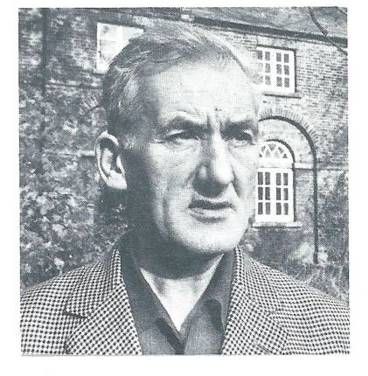
Coke in February 1972, eight months before his death.
And then, very late, something turned. In September 1970 the Abbotsholme Arts Society, run by the school's director of music Gordon Clark, had Moura Lympany booked for a recital at Abbotsholme School in Staffordshire. Clark had met Coke and admired him, and persuaded her to put two of the Preludes into the programme. Coke was in the hall, and the audience acclaimed him. The whole recital was broadcast, and the two preludes went out again on Radio 3 on 26 August 1971, the only music of his the BBC is known to have broadcast in thirty-two years. A BBC interview and a recorded recital followed, and then the articles: a producer from Radio Derby came out to Brookhill and wrote the piece quoted earlier, and Radio Derby commissioned the newly formed Alfreton Hall String Quartet to record one of his chamber works.
At a National Trust concert at Sudbury Hall, also arranged by Clark, Coke met the flautist Christopher Hyde-Smith and his wife, the harpist Marisa Robles. They commissioned a trio for flute, harp and viola from him on the spot. A quartet was commissioned as well. "It was as if a door had opened," wrote Robert Innes-Smith, who knew him, "after being tightly locked for a very long time." Brookhill itself filled up: the local council asked whether the house could be used as a last stage for young people recovering from drug addiction, and Coke agreed at once. They painted the outside, redecorated, and, in Innes-Smith's phrase, "brought warmth and light again into the darkened rooms".
None of it was in time. He was a sick man by then and he knew it, and he did not finish the commissioned pieces; he told people he was dissatisfied with the way the work was shaping. He had waited thirty years for the door to open and had about two years of it.
He remained perfectly clear about what he was doing and why. Asked in 1972 whether he should have tried to move with the times, he said: "You can only compose the music you feel. I am what I am, and this is the music I feel." Asked whether it had been disappointing to see fame disappear so quickly, he answered: "Yes, bitterly disappointing, but I've made myself keep on working."
Two people who came to the house have described it. Hazel Byard, whose family lived in the coach house at Brookhill when she was small, remembers that "Rogers music room was close by and my sister and I would lie on the floor in the doorway and listen to him play, I don't think he knew and we had no idea he was a brilliant pianist we would be about 5 or 6". And in 1963 Joy Fuller, then seventeen, was received at the house and sent away with signed copies of the Third Piano Concerto and the Fifteen Variations, two press cuttings and a printed list of his works. "He told me to keep them," she wrote fifty-four years later, "as someday he may be properly recognised." She also remembered that he was sad that Britten was so successful, and that he had had to pay to have his own opera performed.
His warmth survived too. The letters he wrote in the 1960s to Brian Suter, a young Mansfield tenor who had begun to sing his songs, are among the most likeable things in the archive. "I hope we shall work together often," he wrote in November 1963. "I have wanted a tenor for years. Now I have found one." A few months later: "Please dont call me Mr. Coke! … We will have a good run through and then we shall have to have another, then you will know them for the rest of your life." In 1965, home from hospital: "I am back here now, after 55 days in hospital (where I was allowed to practise however) and 17 days at my sister's house. Its grand to be back, do come over." Of his own illness he wrote just once, plainly: "I have been rather unwell on and off all during the last 2 years, so have been unable to give any concerts. Very disappointing."
There is one witness to those last years from outside the family. Peter Wildsmith was a student psychiatric nurse at the Pastures Hospital at Mickleover, near Derby, from 1971, and knew Coke there until he died. "I would hear Roger playing the Grand piano in the Main Hall during the daytime," he wrote in 2017, "simply playing and chain-smoking for most of the day." He visited Brookhill too, and found the composer in the kitchen of the big house with one other person in it, a housekeeper, a great round table between them and bread and jam in the middle. What he remembered above the rest was this: "Beyond all this I am left with the memories of a wonderful musician and lovely gentleman."
There was one piece of luck at the end. A new drug, the first effective treatment available to him, gave him roughly a year free of the illness that had taken most of his adult life. "The tragedy," Brook wrote, "is that he died only a few days after his sixtieth birthday in October 1972, when he had just had a year or so free of mental illness, having been treated successfully at last with one of the new drugs recently developed."
Where he spent that last year is not something the papers settle, and the likeliest answer is that it was both places. His niece describes a man at home and well. Peter Wildsmith knew him as a patient at the Pastures, playing the hospital piano in the main hall through the day, and also visited him at Brookhill and saw the state he was living in there. A man treated successfully in hospital is still in hospital, and a man who is discharged goes home. What the last months are documented as containing is a house full of young people recovering from addiction, a producer from Radio Derby in the music room, a commission he could not finish, and a bicycle ride into the village after dark.
He died on Monday 23 October 1972 of pulmonary oedema, chronic bronchitis and coronary atheroma. He had gone out on his bicycle after dark to buy cigarettes, and was found lying in a ditch at the edge of the woodland that surrounds the house. The Derbyshire Times reported four days later that the bicycle was undamaged. He did not come off it. He stopped, and his heart and lungs gave out, and he was dead on arrival at the General Hospital, Mansfield. The Mansfield District Coroner was informed and the police issued a statement saying there were no suspicious circumstances; a post mortem was held without an inquest.
The stone over him in the churchyard reads ROGER GEORGE SACHEVERELL COKE, MUSICIAN AND COMPOSER, OF BROOKHILL HALL, OCTOBER 20 1912, OCTOBER 23 1972. Only one other source, a newspaper report of 1933, gives his middle name, and nothing else carved anywhere records the day of his birth. The tablet inside the church names him the same way, with his father and his mother, all of Brookhill Hall.
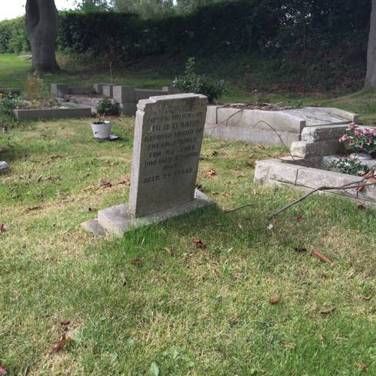
The headstone at St Helen's, Pinxton. Photographed by Simon Callaghan, 4 January 2017.
He was buried on Saturday 28 October at St Helen's, Pinxton, at eleven in the morning, the Rector, the Rev. Ronald L. Gwyther, taking the service and Stephen Dye at the organ. About two hundred people came, among them representatives of the world of music and of a great many local organisations, and his nephew Christopher Darwin, a Royal Navy lieutenant then serving in France, hired a private plane to get there. The Musical Times gave him six lines, and misprinted the title of his opera.
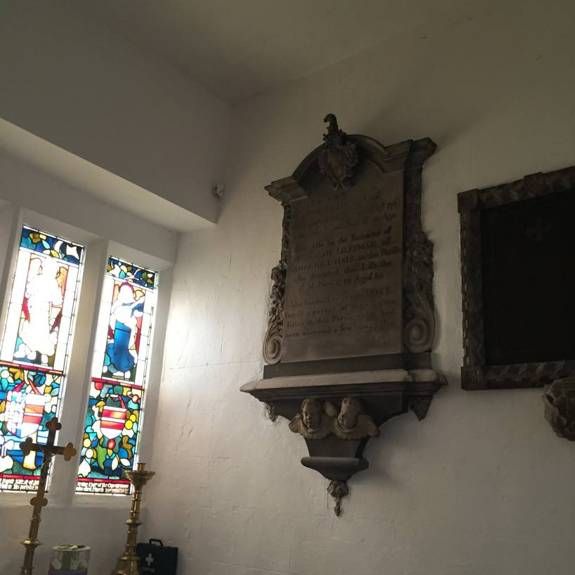
The memorial tablet inside St Helen's, Pinxton, which names Coke with his father and his mother, all of Brookhill Hall. Photographed by Simon Callaghan, 4 January 2017.
The certificate gives his occupation as "of private means", which is what the state made of him. In the will he had written himself he is "Musician and Composer", and he signed it, as he sometimes did, "Sachevrell" (sic.). The estate came to a hundred and thirty-six thousand pounds gross, of which thirty-six thousand went in duty.
Four hundred pounds went to Annie Graney of Brookhill Hall, a name that appears in the written papers only in his mother's wage column, where it starts in 1944. Griselda Brook has since filled the name in. The Graneys lived at the lodge by the entrance gates; Mr Graney died at about the outbreak of the war, and Annie stayed on there and did a great deal of the caring for Roger. The legacy is the measure of what that was worth to him.
The house and land went to his nephew, John Christopher Sachevrell (sic.) Darwin, who had been born on 29 February 1944, three weeks after his grandmother began driving his uncle to Alderley Edge. Brookhill Hall was put up for sale by his two nephews at the end of August 1974, advertised by Strutt and Parker as a Jacobean and Georgian house needing restoration, on eight acres, with planning permission for institutional use. It sold as a private residence that autumn. The stable block containing the music room, a separately listed building of its own, was held back from that sale: Andrew Darwin told a reporter six weeks beforehand that "the stables, containing the room, are separate from the house and will not be sold", and he and his family were by then living in a converted cottage among those buildings. What became of the music room afterwards is not recorded in the papers that survive.
The contents went under the hammer in the hall itself on Wednesday 27 November 1974, upwards of three hundred and fifty lots, with car parking in the grounds and an illustrated catalogue at fifty pence. About three hundred people came, some from abroad, and the day made a little over seventeen thousand pounds. The oak tridarn fetched £880 and the Chippendale mirror £820. A pianola-type harmonium went for £32. And among the seventeen oil paintings sold was lot 109: "Handsome portrait painting of Mr Roger Coke as a young boy stood erect holding his father's sword", with a label on the reverse reading "Roger, Son of the Late Lieut L. Satcheverell Coke". It was the picture he had told a reporter four years earlier was the thing he treasured most of all. The sword itself was lot 84, seventy-five lots before it. Neither report of the sale records what either made or who bought them, and where they are now nobody knows.
One lot can be followed. Beside the oak tridarn of 1727, the £880 that was the day's top price, somebody who was there wrote in the margin of a catalogue: "now at Holme Pierrepont Hall". Two of the lots should not have been in the sale at all. The portrait of Hugh Peters, Cromwell's chaplain, and a George III loving cup of 1772 both stand on the schedule of heirlooms that the settlement of 1908 had reserved to the house for ever. How that trust came to be broken the papers do not say.
There is one other thing the certificate settles. It gives his birthplace as London. Every account of him written since, including the fullest study of his music, has said Alfreton, Derbyshire.
Contents · Previous: Printing it himself · Next: Afterwards
© Simon Callaghan 2026. This account was written from my own research archive on Roger Sacheverell Coke, with AI assistance in drafting. Every statement in it rests on a document listed on the sources page.