
© Kaupo Kikkas
In the dining room at Brookhill Hall there hung a painting of a small boy holding his father's sword. The boy was Roger Sacheverell Coke, aged about seven, and the painter was George Bird. Coke used to date his own beginnings from it: he told an interviewer that he had started composing before he knew a note of music, perhaps as early as 1919, the year the portrait was painted. The sword had belonged to Lieutenant Langton Sacheverell Coke of the 1st Battalion, Irish Guards, killed at Ypres on 31 October 1914, eleven days after his son's second birthday. He was thirty-six, and he has no grave: the Commonwealth War Graves Commission commemorates him on the Menin Gate, Panel 11, among the fifty-four thousand men of the Ypres Salient whose bodies were never identified. The painting was the nearest thing the family had to one. Coke lived with that picture for the rest of his life. In 1969 or 1970, after thieves had broken into the house and taken paintings and bronzes while he sat at the piano in the music room and heard nothing, a reporter asked him about the loss. "My father was a colonel in the Irish Guards," he answered, "but I am pleased to say that an oil painting I treasure most of all has not been stolen. It is of myself as a little boy holding my father's sword." The paper printed it under the heading "Consolation note". Two years after he died the picture and the sword were sold out of the house on the same afternoon, seventy-five lots apart. The sword was lot 84, an officer's dress sword by Binnie and Mason of Old Bond Street. The portrait was lot 109, with a label on the back reading "Roger, Son of the Late Lieut L. Satcheverell (sic.) Coke". Neither has been traced since.
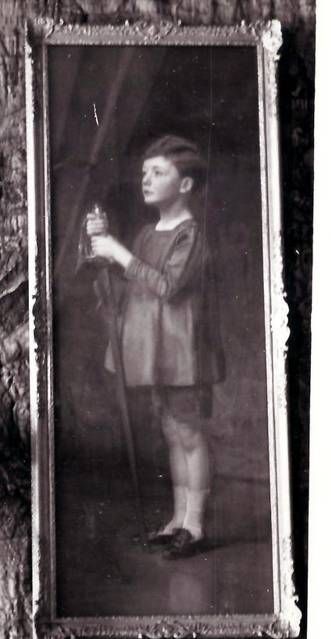
Roger Sacheverell Coke as a boy, holding his father's sword. Painted by George Bird in 1919 and photographed hanging at Brookhill Hall; the painting was sold out of the house in November 1974 and has not been traced since. From the papers of Brian Suter.
He was born in London on 20 October 1912 and died at Pinxton on 23 October 1972, three days after his sixtieth birthday. Between those dates he wrote six piano concertos, three symphonies, five cello sonatas, an opera, three symphonic poems, and songs by the dozen. He told a local paper in 1951 that he had written eighty-six of them in thirteen years, not counting those he had withdrawn. Almost none of it was heard outside Derbyshire and Nottinghamshire, and by his own count the BBC broadcast seven items of it in a working lifetime. A great deal of it has still never been performed, and a good deal more was destroyed by the composer before anyone else had the chance to hear it.
Every statement in this account rests on a document in a catalogued research archive. The sources page gives the reference for each of them, chapter by chapter.
© Simon Callaghan 2026. This account was written from my own research archive on Roger Sacheverell Coke, with AI assistance in drafting. Every statement in it rests on a document listed on the sources page.